Author: spierzchala

  • Browser Wars: StatCounter Data for Europe

    In the previous installment in this series, I looked at the browser share in North America. Across the water in Europe, the browser distribution metrics show the unique flavor that this continent brings to this fluid arena.

    In Europe, MSIE7 and Firefox 3 are effectively tied for the lead as the most dominant browser, followed distantly by MSIE6. As in North America, MSIE8 has substantially increased it’s market share since its March 19 2009 release, but it has not caught up to Europe’s favorite son, Opera 9.6.
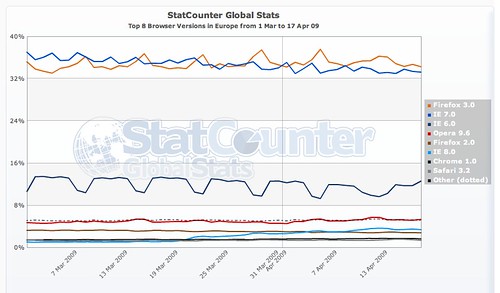
    browser-wars-eu-mar1-apr172009-line

    What is clear is that MSIE8’s gain is MSIE7’s loss. Comparing March 1-19 with April 1-19, the shift away from MSIE7 is almost equal to the shift to MSIE8, meaning that people that are upgrading to MSIE8 in Europe are doing so, in the most part, directly from MSIE7.

    There is little or no change to the MSIE6 install base, indicating that this is an entrenched population, likely in large corporations or government agencies.
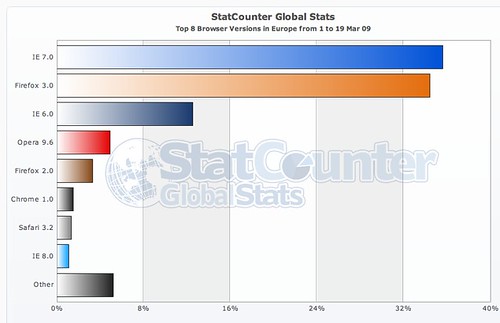
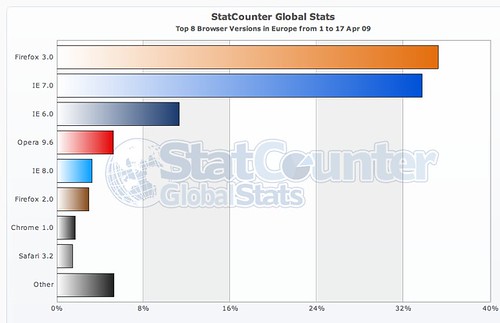
    browser-wars-eu-mar1-192009-bar
    browser-wars-eu-apr1-172009-bar

    Like in North America, the big factor to watch is how quickly the MSIE6 population decreases. Europe already has an entrenched population of alternative browser users, mostly with Firefox 3. When Opera 10 and Firefox 3.1 are released, it is likely that these people will move directly to these browsers.

    What remains to be seen is how the strong anti-Microsoft sentiment in Europe affects the adoption of MSIE8.


  • On the persistence of family – William A Kinnear

    The call came this morning.

    It really wasn’t unexpected. Whenever I get one of those rare calls from my mother, I half expected the reason was to tell me that he had passed. It’s that aching feeling of tension that the ringing phone was going to tell me that he was gone.

    My grandfather and I were from very different worlds. He spent too much of his life underground. His knees, shoulders, hearing all showed that.

    His world was experienced through the muscles, the bones. His world was wrenched from the earth, shaped by his hands, pulled from the grime of machines.

    It was a world of men, a world that is as incomprehensible to me as mine was to him.

    I knew he was a ladies man. You know the one: Dashing, attractive with a strong temper and a brooding, unpredictable temperament. The man of mystery that all ladies ask about.

    He was faithful to one woman, my grandmother, until the day she died. Their relationship was a war between personalities, that explosive combination of friction and passion that made it one of the strongest bonds I have ever seen.

    He mourned her until the day he died. Whenever I visited, the discussion eventually drifted around to his Nettie. That distant look came over his failing blue eyes, the panorama of memory clearly playing on his face.

    My grandfather and I shared one thing: The powerful mood swings that were fueled by the same catastrophic failure of our brains to handle the world in a reasonable way.

    I found peace through medication. Grandpa started with the numbing power of rye to help take the edge of his mental anguish. And when he was forced to make a choice between the drink and his life, he chose his life and left the drink behind.

    He took the restless energy that drove him to drink and channeled it into the furniture he restored.

    People from far and wide brought him pieces that were lost, beaten, destroyed. In his hands, their inner beauty was exposed.

    Each piece of furniture was a piece of his life that he was atoning for. A mistake that he was trying to repair. A memory he was sharing. Those memories are scattered now, among family, friends, strangers. And with each memory shared, he ensured that he would live on.

    His best gift to me was to help me realize that the mistakes of youth can be restored, repaired, but memory reminds us that they can never be undone.

    I miss you grandpa. Travel in peace.

    William A. Kinnear – 1919-2009.

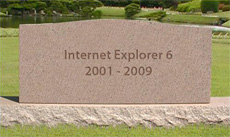
  • MSIE6 Euthanized. Rejoicing Among Web Developers Begins.

    It’s official. According to the IE Dev Blog at MSDN, MSIE8 will be the direct upgrade path via Windows Update in the third week of April. [here]
    I discussed the slow decrease in MSIE6 browser share earlier today, but it is not occurring fast enough for my liking. It is a browser from what seems like a generation ago.
    To give you some idea of why MSIE6 should gently euthanized, when it was a shiny new browser:

    • Facebook, MySpace, GMail, and YouTube did not exist
    • You could count the number of bloggers (remember them?) on one hand
    • UserLand was the primary blogging tool. Or a text editor.
    • Scoble didn’t work for Microsoft
    • Excite and AltaVista were still viable search engines

    Is it too early to write a redirect rule to direct MSIE6 users to a page telling them to upgrade to view content?
    [Image courtesy of CreativeBits]

  • Browser Wars: StatCounter Data for North America

    Tracking browser penetration and market share has become a new obsession with me. With 2009 shaping up to be the year of the browser container, the choices that people make will affect the development of Web technologies for the next few years.
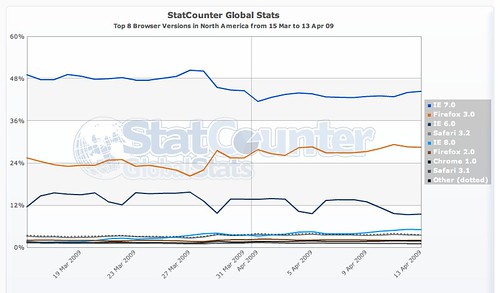
    So far, the only new player to come out of the gate as a production release is MSIE8. Since March 19, MSIE8 has seen a slow and steady increase in market share, at least in North America. This has occurred, as I have noted previously, without the support of Windows Update, which will drive millions of users to automatically upgrade their systems.

    NA-browser stats-MAR15-APR132009

    What can be seen in this data from StatCounter is that MSIE8 is finally (Thank [insert deity or supernatural object here]!) taking market share away from MSIE6. As the corporate browser of choice (mainly because IT departments don’t have the resources or initiative to sign-off on MSIE7), MSIE6 is the default platform that all developers are forced to lower their standards to.
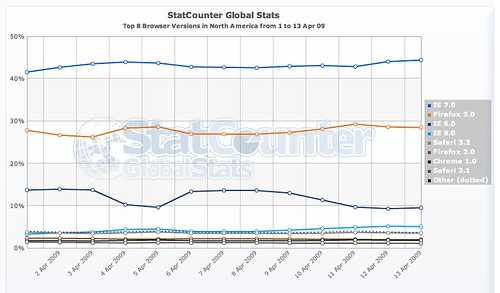
    One can hope that IT departments will allow their customer base to make the leap directly to MSIE8 from MSIE6. We can all celebrate now, as the StatCounter data now shows that MSIE6 has dropped below 10% market share.

    NA-browser stats-APR1-132009

    What is more interesting is that Firefox 3.0 made a serious encroachment into MSIE7 near the end of March. I am not aware of what may have caused this, and would be interested to hear if the StatCounter team has any insight into why this may have occurred.

  • Scaling Web Analytics – Considerations for Consumers

    A comment on my Hit Tracking with PHP and MySQL post raised some interesting questions about what a consumer of Web analytics data needs to consider when selecting providers for their sites.
    Most folks are familiar with the model of Web analytics vendors: You place their JS tag on your page which makes a call back to their centralized system with all of the data that can be collected about the visitor who has just come to your site.
    There are three items that you, the consumer of this third-party service, need to get straight answers about.

    Performance of the Tag

    Visitors to your site do not know which components you are responsible for and which you have farmed out to vendors and services. In their mind, all content is your content. This means that the performance of the Web analytics tag, which if not placed correctly on the page can affect the rendering of the content, is a critical factor in selecting a vendor.
    To my knowledge, none of the Web analytics vendors used by most people blog and social media firms (StatCounter, GetClicky, Google Analytics, Omniture, etc.) freely share response time and error rate metrics of their tag infrastructure with the world as measured by a third party.
    Is the tag delivered from a central location, or does the provider use a CDN? Is the data delivered asynchronously or synchronously?
    The download performance of the tag is not the only concern. Ask them to provide data on the average processing time that they see when a client parses and processes the code. How does this processing time vary from browser to browser, between OSs? What steps are they taking to ensure that the tag does not affect the perceived performance of your page?
    Ask for this data. Ask that the measurement data be collected by an impartial third party. Demand that this data be freely available to you before you make a decision on purchasing their service.

    Size of the Tag

    All of these services rely on a JS tag to collect and deliver the data to their data warehouse. Ask the provider to tell you how large this tag is, and what steps they have taken to reduce its size so that it has a limited effect on the download of your content.
    Have they minified the tag? Is it delivered using HTTP compression to further reduce the size? Are ways to reduce the size of the tag always under considerations?

    Data Storage

    Analyzing data takes a couple of forms: daily operational views to spot changes or issues; and long-term trending to find larger patterns and major shifts in your visitors. As a result, data needs to be available with a substantial degree of detail while still providing aggregated data that allows larger patterns to be easily discovered.
    How long does your provider store detailed data? What is the data expiry policy? Can you extract the data and import it into your own database?

    Summary

    Web analytics is key to determining what works and doesn’t work on your site. It tells who, where and how people are accessing your content. But without a Web analytics partner/vendor that provides performance and support, you may be left more in the cold than if you were just looking at your raw Web logs.

  • IPV4 and Registrar Data – April 10 2009

    From my IPV4 database, here are the the Registrar and Country statistics as of April 10 2009.

    Since the last update, ARIN has crossed the 1.6B IPV4 address boundary, adding nearly 5M IPV4 Addresses. APNIC matched this growth by adding an additional 5M new addresses of its own.

    Registrar      Number of IPV4 Adresses
    ---------      -----------------------
    arin                    1,600,640,000
    ripencc                   564,850,616
    apnic                     528,362,496
    lacnic                     79,931,136
    afrinic                    21,526,272

    The majority of the growth in APNIC continues to be driven by China, which added an additional 4M IPV4 addresses since March 14.

    Country                                     Number of IPV4 Adresses
    ------------------------------------------  -----------------------
    UNITED STATES                                            1472741888
    CHINA                                                     191119104
    JAPAN                                                     152412672
    EUROPEAN UNION                                            114155680
    GERMANY                                                    85174424
    CANADA                                                     75846144
    KOREA, REPUBLIC OF                                         72142592
    UNITED KINGDOM                                             70675288
    FRANCE                                                     68370880
    AUSTRALIA                                                  36573184
    ITALY                                                      32202432
    BRAZIL                                                     29754880
    TAIWAN, PROVINCE OF CHINA                                  24680704
    RUSSIAN FEDERATION                                         24529224
    SPAIN                                                      21794976
    MEXICO                                                     21504000
    NETHERLANDS                                                21290792
    SWEDEN                                                     18982304
    INDIA                                                      18285568
    SOUTH AFRICA                                               14009344
    POLAND                                                     13869704
    TURKEY                                                     10417600
    DENMARK                                                     9281632
    FINLAND                                                     8932864
    ROMANIA                                                     8640512
    SWITZERLAND                                                 8249320
    HONG KONG                                                   8206848
    NORWAY                                                      7425584
    AUSTRIA                                                     7290592
    ARGENTINA                                                   7239424
    INDONESIA                                                   6997248
    VIETNAM                                                     6707456
    BELGIUM                                                     6412416
    NEW ZEALAND                                                 6115072
    CZECH REPUBLIC                                              6040960
    UKRAINE                                                     5507904
    THAILAND                                                    4743936
    CHILE                                                       4731136
    PORTUGAL                                                    4473952
    SINGAPORE                                                   4410880
    COLOMBIA                                                    4261632
    IRELAND                                                     4203680
    MALAYSIA                                                    4147456
    PHILIPPINES                                                 4070656
    ISRAEL                                                      3949760
    GREECE                                                      3834624
    HUNGARY                                                     3716480
    VENEZUELA                                                   3693056
    BULGARIA                                                    3334912
    EGYPT                                                       2731008
    SAUDI ARABIA                                                2703616
    UNITED ARAB EMIRATES                                        2286848
    LITHUANIA                                                   2009216
    IRAN, ISLAMIC REPUBLIC OF                                   1894400
    PERU                                                        1715968
    PAKISTAN                                                    1637632
    CROATIA                                                     1623136
    SLOVAKIA                                                    1611520
    COSTA RICA                                                  1502208
    LATVIA                                                      1384448
    SLOVENIA                                                    1277952
    PANAMA                                                      1130240
    MONTENEGRO                                                  1083648
    ESTONIA                                                     1021464

    As China’s Internet growth continues, the number of addresses assigned to ISPs in that nation will continue to grow. However, it is unlikely that China will equal or exceed the US mainly due to the movement to mobile devices, which will be managed using private IP space rather than public IPs.

  • Why Chrome 2.0 Dev was Deleted

    I deleted Chrome 2.0 from my system on Friday for one very powerful reason: When it is installed, it makes itself the default browser.
    Its performance gains and light weight were impressive. But its invasion of my system was uncalled for.
    No matter which browser you set to be the default browser, Chrome 2.0 prevents that browser from regaining control. If you click a link in another program, Chrome launches, even if you set MSIE or Firefox or Safari as the default browser.
    I thought that kind of behavior was behind browser manufacturers.

  • The Rise of MSIE 8


    In the 10 days since its public release, MSIE8 has made a run up the charts. Courtesy of the great folks at StatCounter and their public analytics data, this growing browser share for MSIE8 can be easily followed.
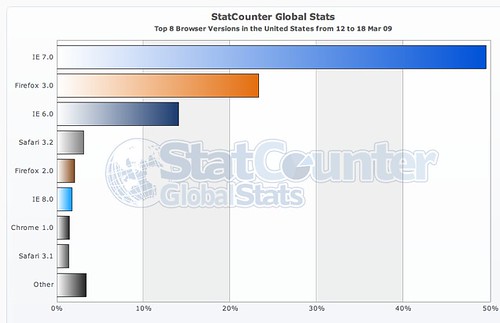
    In the US, prior to its release, MSIE8 RC1 was in sixth position behind even the old battleship Firefox 2.0, but ahead of Chrome 1.0.

    msie8-week-mar12-182009

    In the week following its release, MSIE has quickly surpassed Firefox 2.0 browser share in the US. I am not really sure who these Firefox 2.0 users are, but they and the MSIE6 users must be found and encouraged to immediately upgrade.

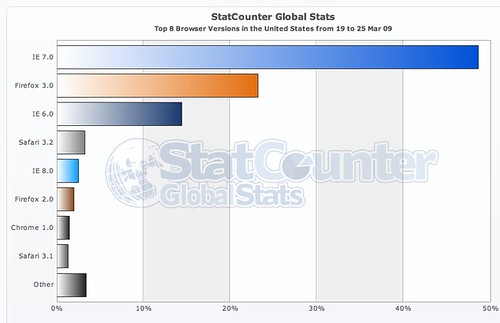
    msie8-week-mar19-252009

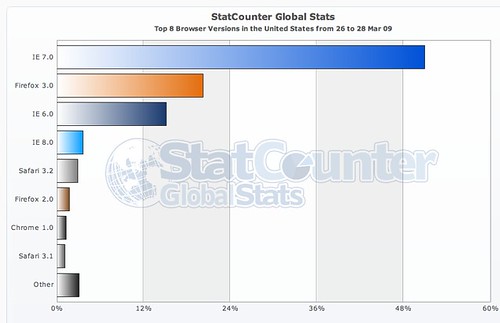
    The values for the first week don’t tell the entire story. As it enters its second week of general availability, MSIE8 continues to increase its share of the browser market, moving into fourth place in StatCounters US stats, overtaking Safari 3.2.

    msie8-week-mar26-282009

    What does t his mean? While it still has a long way to go before it comes close to approaching even the dinosaur, MSIE6, it has to be said that this growth in MSIE8 browser share has occurred without the use of Windows Update. People are making a conscious decision to switch to and use MSIE8.
    Site and application designers will need to take heed – MSIE8 compatibility initiatives will have to be in place yesterday rather than some vague time in the future.

  • Web Performance: The Rise of Browser Computing

    The next generation of browser all tout that they are able to more effectively deliver on the concept of cloud computing and Web applications. That may be the case, but it changes the entire world of Web performance measurement and monitoring.

    The Web performance focus for most firms is simple: How quickly can code/text/images/flash can be transferred to the desktop?

    The question that needs to be asked now is: What effect does my content have on the browser and the underlying OS when it arrives at the desktop?

    Emphasis is now put on the speed and efficiency of Web pages inside browsers. How much CPU/RAM does the browser consume? Are some popular pages more efficient than others? Does continuous use of a browser for 8-12 hours a day cripple a computers ability to do other tasks?

    The performance measurement will include instrumenting of the browser. This will not be to capture the content performance, but the browser performance. Through extensions, plugins, accelerators, whatever browsers will be able to report the effect of long-term use of the health of the computer and how it degrades the perceived performance over time.

    Many solutions for page-performance tracking have been implemented using JavaScript tags, etc. What would be interesting to many developer is to see the long-term effects of the Web on certain browsers. This information could be tagged with specific event markers, DOM events, plugin usage (Flash, Silverlight, Java), and other items that indicate what events truly effect the browser.

    Most browsers provide users and developers tools to debug pages. But what if this data was made globally available? What would it tell us about the containers we use to interact with our world?

  • GrabPERF Updates being planned – Hostname Resolution Data


    Tonight, I figured out how to add the Resolved IP Addresses for a host to measurement data and store that information for further debugging. It was very simple – I was trying to find complex solutions to this issue.
    Turns out the solution is built right into PERL: The Socket module.
    My thought is that I will update the table with the test config with three new columns:

    • HTTPS/HTTP
    • Hostname
    • Page information

    There will likely be a new table that joins with the raw data on

    • Date
    • Agent_id
    • Test_id

    And contains a comma-delimited list of all the IP addresses that the agent resolved the hostname to at the test time. This lookup will be run after the measurement, so the DNS lookup component of the measurement is not compromised.
    I don’t have an ETA on this, as I want to test it fairly thoroughly before I expose the data. Adding the columns to the test config table will be transparent, but agent modification will need to be verified and then rolled out to all of the folks hosting measurement locations.
    What problem does this provide a solution to?
    It is vital for firms who use geographic load balancing and CDNs to verify that their data is being served from location appropriate IP addresses. I will be able to tie the information collected here into the IP-Location data I collect for other purposes and help companies ensure that this is being done.