Author: spierzchala

  • GrabPERF Updates being planned – Hostname Resolution Data


    Tonight, I figured out how to add the Resolved IP Addresses for a host to measurement data and store that information for further debugging. It was very simple – I was trying to find complex solutions to this issue.
    Turns out the solution is built right into PERL: The Socket module.
    My thought is that I will update the table with the test config with three new columns:

    • HTTPS/HTTP
    • Hostname
    • Page information

    There will likely be a new table that joins with the raw data on

    • Date
    • Agent_id
    • Test_id

    And contains a comma-delimited list of all the IP addresses that the agent resolved the hostname to at the test time. This lookup will be run after the measurement, so the DNS lookup component of the measurement is not compromised.
    I don’t have an ETA on this, as I want to test it fairly thoroughly before I expose the data. Adding the columns to the test config table will be transparent, but agent modification will need to be verified and then rolled out to all of the folks hosting measurement locations.
    What problem does this provide a solution to?
    It is vital for firms who use geographic load balancing and CDNs to verify that their data is being served from location appropriate IP addresses. I will be able to tie the information collected here into the IP-Location data I collect for other purposes and help companies ensure that this is being done.

  • Legitimate DNS Hijacking and You

    DNS hijacking is an occurrence that sends fear into the hearts of man and beast. It takes a perfectly harmless (yet critical) process and turns it into a weapon for chaos and mayhem.
    This tool, however, does not simply reside in the hands of people looking to maliciously redirect traffic for purposes I can’t quite fathom – I’ll admit, there is still some simple naivete in my Canadian mind.
    Legitimate companies, ISPs, service providers also have this tool at their disposal for their own purposes. An useful and accepted version of this exists already in the form of content delivery networks (CDNs) and other third-parties who take a portion of a companies domain name space and use it to deliver distributed edge content and computing, web analytics, or advertising services.
    But let’s move this inside the firewall or into the consumer ISP space. These companies provide DNS for millions of customers. As a result, they could easily re-write DNS entries to reflect their own needs rather than those of the consumer.
    In the case of corporate IT networks, there is not much that can be done – they own the wire, hardware and software being used, so they will claim it’s part of the corporate IT policy that all employees sign and that will be that.
    Consumers, on the other hand, should expect free and unencumbered access to the worldwide DNS network, without being intercepted or redirected by their own ISPs. And there is frankly no way to verify that this is not happening unless you run your own caching BIND server on your home network.
    The alternate is to use one of the external third-party services (OpenDNS or DNS Advantage). But these services also provide Phishing and Filtering services, which means that they can easily modify and redirect an incoming request using the most basic and critical service on the Internet.
    While this may sound like the rant of a paranoid, it is a concept that has practical consequences. As an organization, how do you know that you aren’t on the DNS filter list of these providers, or the ISPs? If they can filter and redirect DNS requests, what else are they doing with the information? Are they providing open and trusted access to the core DNS services of the Internet?
    Stepping back as far as you can into the process of going to your favorite pages, you will find that you can’t get there without DNS. And if DNS can no longer be trusted, even from legitimate providers, the entire basis of the Internet dissolves.

  • GrabPERF Agent Update – DNS


    This afternoon, the two GrabPERF Agents at Technorati were switched back to using their local copies of caching BIND for resolving DNS entries.
    Some folks at Microsoft who stopped by to look at their results on the Search Performance Index noticed that there were one or two outliers in the results from these locations. When I investigated, the OpenDNS name servers I was using were returning odd results.
    The reason I had been using OpenDNS is that the local BIND instances were seeing unusual behavior a few months back. So, consider the switch to the local BIND instances probational, pending ongoing review.
    Thanks to Eric Schurman for letting me know.

  • Browsers and Affect on Revenue

    A great follow-up to my post on Browser Stats is this slide deck from Gomez on Online Revenue and Browsers Performance.

    Protect Your Online Revenue – Best Practices For Ensuring Your Web Applications Perform Across Browsers

    NB: I do work for Gomez.

  • StatCounter Browser Stats – March 1-24 2009

    Using the visitor trending data collected and shared by StatCounter, I have undertaken a general analysis of browser distribution by global region. These metrics are collected using the embedded tags that StatCounter customers embed on their site to collect visitor metrics for their own use.

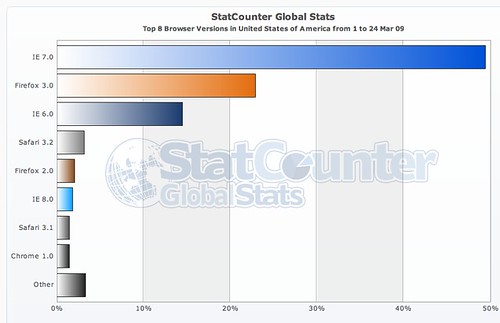
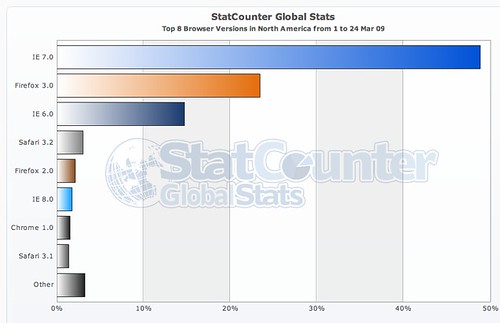
    US data shows that MSIE 7.0 is in a dominant position, with Firefox 3.0 in the 25% range of market share. This trend extends into the North American data, which is heavily influenced by the US trend.

    MSIE 8.0, still reports a lower distribution than Firefox 2.0. This data is most likely based on the usage of MSIE 8.0 RC1 version, as MSIE 8.0 was only released in GA last week. It is highly probable that these stats will change in the very near future with the release of MSIE 8.0 to Windows Update.

    StatCounterGlobalusa-1-24mar2009
    StatCounterGlobalna-1-24mar2009

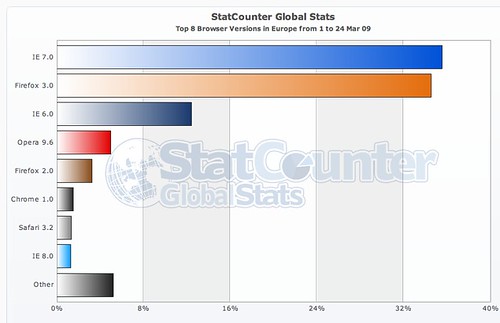
    In the EU, where fear and loathing of Microsoft runs deep and true, Firefox 3.0 is approaching parity with MSIE 7.0. Also, the perennially favoured native son Opera makes a very strong showing with their 9.6 release.

    StatCounterGlobaleu-1-24mar2009

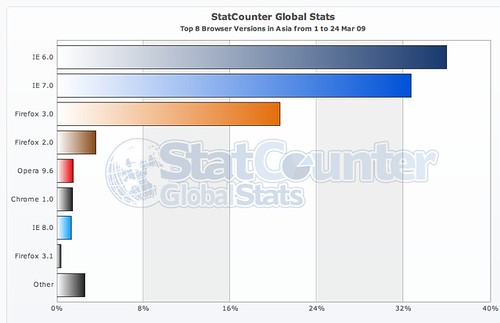
    Asia is a Web designers nightmare, with MSIE 6.0 continuing to be the most reported browser. This is concerning, not simply for design reasons, but for web compliance reasons. Effectively Asia has throttled Web development to an old warhorse, but to such a degree that there must be some overriding advantage to using this browser.

    StatCounterGlobalasia-1-24mar2009

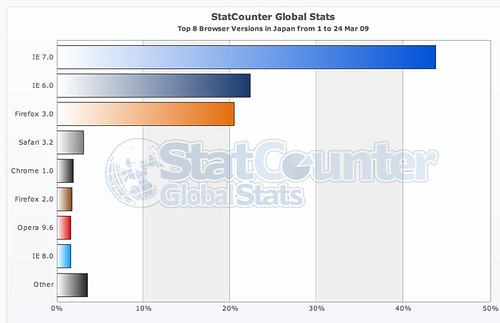
    As an example, the statistical comparison of four Asia nations is broken out below. We’ll start with Japan where MSIE 7.0 has a clear lead in the statistics.

    StatCounterGlobaljp-mar1-242009

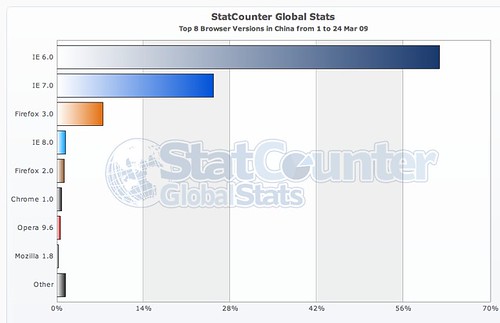
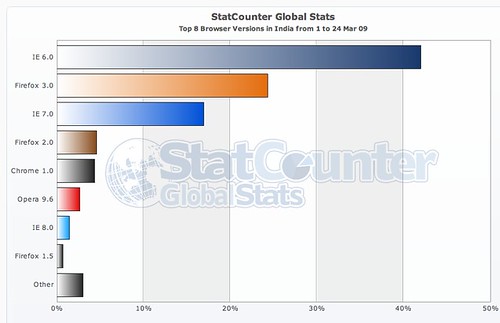
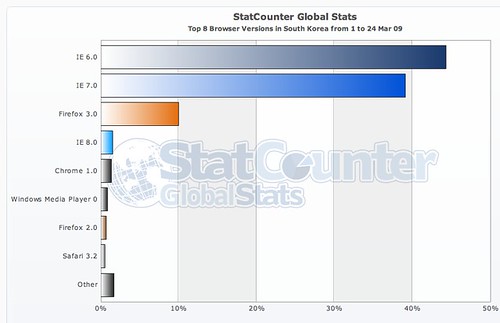
    However, when China (People’s Republic), India, and South Korea are added into the analysis, the pull towards MSIE 6.0 is massive.

    StatCounterGlobalcn-mar1-242009
    StatCounterGlobalin-mar1-242009
    StatCounterGlobalkr-mar1-242009

    This trend needs to be studied in greater detail in order to understand why MSIE 6.0 is so popular. Is it because of licensing? Continued use of Windows 2000? Compromised computers? The data doesn’t provide any clear or compelling reason for this trend.

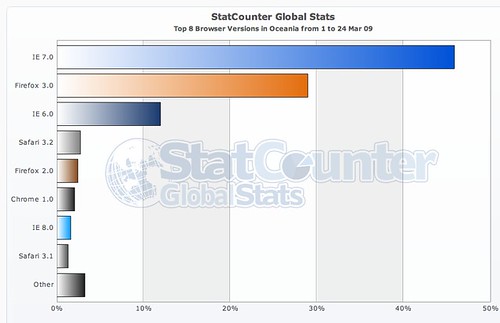
    Moving to Oceania shows a return to the trend of MSIE 7.0 being the predominant browser with Firefox in second place, with these two browsers showing a substantial lead over the remaining field.

    StatCounterGlobaloc-1-24mar2009

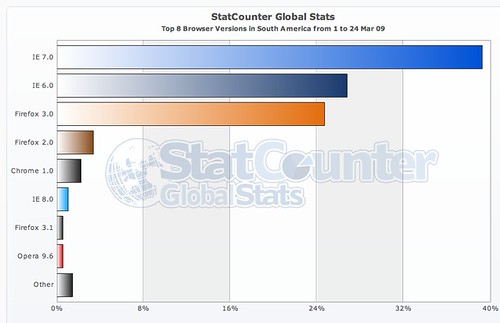
    South America sees MSIE 7.0 as having the largest market share, followed by MSIE 6.0 and Firefox 3.0. Effectively there are no other browsers with substantial market share at present.

    StatCounterGlobalsa-1-24mar2009

    These statistics show that the three most dominant browser platforms by market share are the two MSIE platforms followed by Firefox 3.0. This is likely to change with the MSIE 8.0 GA last week and its predicted release to the masses via Windows Update in the near future.

    However, the release of MSIE 8.0 may not be as exponential as is predicted. Corporate IT policies, which have been slow to embrace MSIE 7.0, are likely not going to make a giant leap to MSIE 8.0 overnight. Adoption among the general population will also depend on the ability of existing Web applications to adapt to a more standards-compliant browser platform.

    Noticeably absent from most of these statistics is Safari in a position to challenge the three leading browsers. This indicates that even hardcore Mac users continue to use Firefox as their primary Web application and browsing platform. StatCounter backs this up by indicating that within their data, 8.36% of visitors from the USA were on Macs, while 3.15% of visitors used Safari.
    Trends to watch in the near future:

    • New browser releases (Firefox 3.1, Safari 4.0) and their effect on browser distribution
    • Uptake of MSIE 8.0 once it is released via Windows Update
    • Browser distribution is Asia
  • Search Referrer Stats – March 21 2009

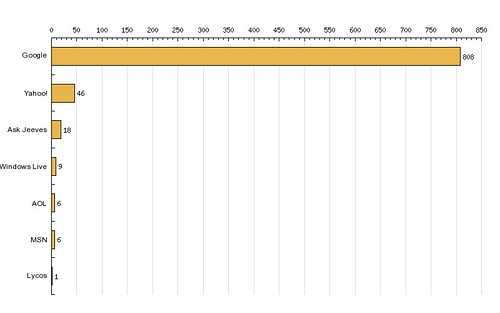
    Via Statcounter, here is my search engine distribution for a log of 2,000 hits.

    search-distribution-march212009

    With statistics like these, is there really any point in having other search engines?

  • GrabPERF Search Index – March 13-19 2009

    About four years ago, I published/posted a number of indices related to GrabPERF data. This is a re-launch of that, starting with the GrabPERF Search Performance Index.
    The methodology of the Search Performance Index is straightforward: A number of key search providers are selected and HTTP GET requests are sent that directly pull the results page of a query page that is searching for ‘New York’.
    This is a simple process and one that is a close approximation of the actual search process that hundreds of millions of people perform every day.

    alias                       Response Time  Success  Attempts  Success Rate
    --------------------------  -------------  -------  --------  ------------
    SEARCH - Google Blogsearch      0.2822545    27242     27244       99.9927
    SEARCH - Google                 0.3151932    27228     27247       99.9303
    SEARCH - Live (Microsoft)       0.3840097    27245     27246       99.9963
    SEARCH - Indeed                 0.4112960    27240     27241       99.9963
    SEARCH - Yahoo                  0.4574381    24175     24175      100.0000
    SEARCH - Altavista              0.4592764    23922     23922      100.0000
    SEARCH - Cuil                   0.6757475    23963     23967       99.9833
    SEARCH - AOL                    0.7822945    23913     23913      100.0000
    SEARCH - Ask                    0.9025220    24157     24163       99.9752
    SEARCH - Technorati             0.9053472    27219     27234       99.9449
    SEARCH - Amazon                 1.3251402    27245     27251       99.9780
    SEARCH - Baidu                  1.7409345    23777     23799       99.9076
    SEARCH - Blogdigger             1.8960633    25106     26354       95.2645
    SEARCH - BlogLines              2.0238809    27233     27248       99.9450
    SEARCH - IceRocket              2.1233684    24147     24177       99.8759
    SEARCH - Blogpulse              2.4144131    27019     27247       99.1632

    As can be seen in the data, there is a substantial degree of difference in the response time results, but the big three search providers (Google, Yahoo, and Microsoft Live) were in the top five. As well, all but three of the providers (Blogdigger, IceRocket and Blogpulse) had success rates (availability) of 99.9% or higher.
    I don’t expect to see much in the way of change in these results, but I will post them for comparison each week.

  • MSIE8 QOTD and other browser war comments

    Here’s what the difference between the companies boils down to: Microsoft is focusing on today’s Web, and the rivals are focusing on tomorrow’s.

    Stephen Shankland via Browser war centers on once-obscure JavaScript

    This sums up many of the comments that I have made about browsers over the months [see Does the browser really matter?]. The browser is not a passive browser any more. It is a Web application portal/container. With MSIE8, Microsoft has not made the leap into the future web.
    It has produced more of the same, and will likely continue to see its percentage of the market drop, at least until Windows 7 rolls with MSIE8 installed as the base browser.
    My final comment is that Windows 7 may not be enough to save Microsoft entirely due to the economic downturn and its effect on the upgrade process within households and corporations.

  • Internet Explorer 8 – Coming to a Site Near You!

    Tomorrow morning, at 09:00 PDT, Microsoft unleashes IE 8.0 on an unsuspecting Internet.
    By 12:00 PDT, the number of Web sites having to put up IE 7.0 only stickers will be in the millions.
    I haven’t done a lot of testing of the new monster (I mainly use Firefox on Mac OS 10.5.6), but it doesn’t seem any weirder than any of the other Microsoft browsers I have used.
    Under the hood, it does amp up the number of connections that are used to download objects, but if your infrastructure is prepared, it should be no big deal.
    The big concern lies in the rendering. If those users who can upgrade to the new browser (anyone not limited to IE 6 by a corporate IT policy written on parchment) do find there are problems, will they blame the site or the browser?
    Have you tested your site to ensure that it actually works with IE 8? Or will you get burned?
    What is the greatest benefit you see to your visitors having IE 8 instead of IE 6 or 7?
    Is this a good thing?

  • Modern Business and the Culture of Assurance

    I often wonder how much business is lost but the levels of assurance that exist within modern companies.

    As information passes through and upward through a company, it is filtered, shaped, refined down to the one salient decision point that all the executives can then discuss. The concern that I have is whether the devolution of detail within organizations stifles their ability to innovate, especially in times of stress.

    Small companies have a short distance from those that create and work with the product to the senior levels. As a result, senior managers and executives are tightly tied to the details of the product, of the company, of the customers. They understand that details are important.

    Mature companies discuss how their strategies and initiatives will shape an entire industry and change the way everyone does business. But how that happens is often lost as those concepts flow downward. Just as detail devolves on the way up, detail evolves on the way down.

    It is nigh on impossible to participate in an industry-defining paradigm shift when your everyday activities double and triple, leading to a complete dissociation between the executive level and the worker level.

    Why does this occur?

    Its not that detail devolves on the way up an organization, but rather that each level needs to assure each higher level that everything is ok and that solutions can be found for those issues that may be challenging, so lets just keep pressing forward.

    So the devolution of detail coupled with the culture of assurance gets too many companies in trouble.

    The devil is in the details. And sometimes, the devil can be your friend.