
I have said it before, and I say it again: the performance profile of the CIA Web Site SUCKS.
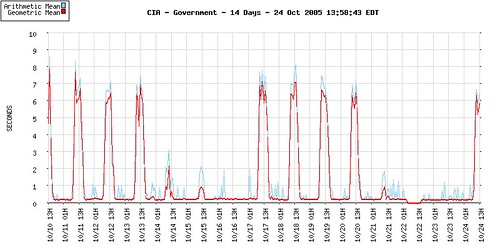
How can you stand this if you are a major government agency? Guess no one at the CIA cares.
I have said it before, and I say it again: the performance profile of the CIA Web Site SUCKS.
How can you stand this if you are a major government agency? Guess no one at the CIA cares.
Normally when I discuss the performance of a page I am measuring using GrabPERF, it’s either good news (“you just got 5 times faster!”) or bad news (“your page hasn’t loaded in 6 months; you still there?”).
Today, something a little different: a question. What’s the question?
Why is the performance of a Technorati Blog (aka Traditional) Search so different from a Technorati Tag Search?
For those of you who have been around for a while, you know that Technorati allows you to search for results based on a Traditional search engine methodology, which is date-ranked, most recent first. It also provides a way to search through the user-defined tags that are appended to posts, or listed as category titles.
The issue that I have been seeing from my measurements is that Tag Searching is performance substantially worse than Traditional Search.


TAG SEARCH
What I need to understand from the Technorati team is the particular technical challenges that differentiate Traditional v. Tag Searching, because the difference in performance is astonishing.
And then there is the success rate of the Tag Search.

When I examine the data, almost all of the errors on the Tag Search measurement are Operation Timeouts. I have set the GrabPERF Agent to time out when no response has come back for the server in 60 seconds. So, effectively 15% of the Tag Searches do not return data to the client in 60 seconds.
So, while the Traditional Search has been tuned and optimized, there appears to be much work left to make the Tag Search an effective and useful tool.
Technorati: technorati, search, tagging, seo
IceRocket: technorati, search, tagging, seo
The gang at the Never Work Alone blog have a fantastic post describing some of the solutions to the Introverted IT / Extroverted Sales-Marketing integration issue.[here]
The best points:
- When hiring, place a premium on being able to explain technical issues to users and determine whether they’ve mastered the material. Expect this to cost more.
- Offer raises for taking training in oral technical communication
- Offer “days off” learning the essential business function of the department. You don’t understand what they do, they often don’t really GET what you do either, nor why its important – gieve them a chance to understand each other
- Train non-IT staff to repeat back in their own words what the IT person explained to them and confirm that they got it right (a good idea for any complex communication)
My eternal salvation comes from falling into the first category listed above. I can tear apart a packet trace and spot issues at the TCP layer, and then turn around and explain this issue to the VP of Marketing in terms that she can understand, and are relevant to her.
That is not dumbing it down, as many IT people feel. This strategy (or survival mechanism) allows a technical person to appeal to a wider audience. Being recognized across your organization, not just in your team, leads to greater rewards in the long run.
This was in my mailbox just now. Huh?!?!?
NEW BBC SERIES
Thinking about having a baby?
We are looking for couples to take part in a new BBC series exploring the science behind getting pregnant and pregnancy. If you are thinking about trying for a baby or have already started trying and would like to find out more, please call us on 0141 204 6620 or e-mail: baby@mentorn.tv
PLEASE DO NOT REPLY TO THIS EMAIL ADDRESS – REPLY TO mailto:BABY@MENTORN.TV
We’d like to advise you that we got your email address from a mailing list company. Their lists are compiled from those who have agreed, when visiting relevant websites, to receive contact from third parties
If you would like to be removed from our list please reply to mailto:BABYLIST@mentorn.tv
I am trying to figure out what list I said yes to to get this email.
The Yahoo! BlogSearch started off showing less than remarkable results in terms of performance (I leave the qalitative judgement to other critics). Over the last 11 days, the team at Yahoo! have realized that there may be an issue, and they have been working on it.
On Thursday afternoon (Oct 20, 2005), they obviously implemented a major change that caused performance to improve dramatically.

This improvement was due to some back-end changes in the search itself. How do I know this? All the improvement came in first-byte (server response time).
HOUR                 AVG_SERVER_RESPONSE
-------------------  -------------------
10/20/2005 00:00:00            1.2159322
10/20/2005 01:00:00            1.2658667
10/20/2005 02:00:00            1.3596000
10/20/2005 03:00:00            1.1870328
10/20/2005 04:00:00            1.1672373
10/20/2005 05:00:00            1.2970500
10/20/2005 06:00:00            1.2220333
10/20/2005 07:00:00            1.3705500
10/20/2005 08:00:00            1.4188667
10/20/2005 09:00:00            1.4439000
10/20/2005 10:00:00            1.5772000
10/20/2005 11:00:00            1.4943559
10/20/2005 12:00:00            1.4794426
10/20/2005 13:00:00            1.4017333
10/20/2005 14:00:00            1.6012500
10/20/2005 15:00:00            1.4380333
10/20/2005 16:00:00            1.1326441
10/20/2005 17:00:00            0.5613000
10/20/2005 18:00:00            0.5656833
10/20/2005 19:00:00            0.5766833
10/20/2005 20:00:00            0.5219831
10/20/2005 21:00:00            0.4722131
10/20/2005 22:00:00            0.5022333
10/20/2005 23:00:00            0.4569138
Would love to hear from the Yahoo team, and learn exactly what they did to bring about such a massive improvement.
The EFF is letting us know that the US Government (your government, not mine) has secretly collaborated with printer manufacturers to embed a unique tracking code in every document coming from your colour printer. [here]
Via: Travis Smith
Looks like the folks at MSN Search have decided to block the GrabPERF measurements of the standard search term.
Oh well, doesn’t bother me. I never really considered them a viable contender for any search title. “Too little, too late” is my personal opinion on the MSN Search experience.
Also, it was the slowest of the Big Three.
Average Performance — Oct 1-19, 2005
MEASUREMENT        AVERAGE  NUMBER
---------------  ---------  ------
Google - Search  0.3524125   18891
Yahoo - Search   0.6395253   18849
MSN - Search     0.7182230   18876
Looking forward to see if anyone from MSN notices…or cares.
UPDATE: MSN Search appears to have fixed their problem. the measurement is now re-instated.
Would sure like to know what happened here.
Technorati: MSN Search, Search, GrabPERF
IceRocket: MSN Search, Search, GrabPERF
Copyright © 2026 Performance Zen
Theme by Anders Noren — Up ↑
